


Welcome to Ramakrishna Mission, Moynapur
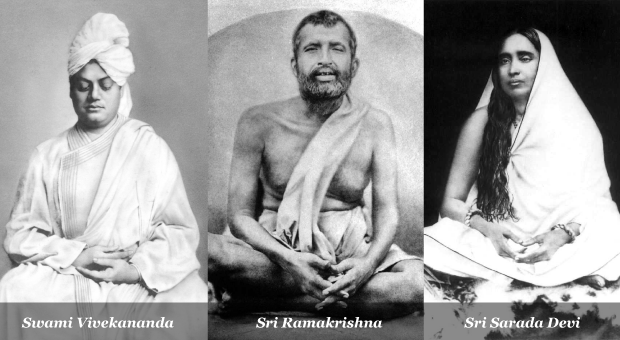 Ramakrishna Mission, Moynapur is not merely a religious institution; it is, at once, a remarkable confluence of spiritual practice, heritage, literature, folk culture, and service. At present, this centre is functioning as an acquired Ashrama of Belur Math and is being administered as a sub-centre under the Ramakrishna Mission Sarada Sevashrama, Jayrambati. Inspired by the ideals of Sri Ramakrishna, Holy Mother Sri Sarada Devi, and Swami Vivekananda, this Ashrama is today well known as a service centre deeply connected with rural social life.
The sanctity of Moynapur lies foremost in the fact that it is the blessed birthplace of the great devotee Akshay Kumar Sen, a householder disciple of Sri Ramakrishna and the author of the Sri Sri Ramakrishna Puthi. Moynapur village, the birthplace of Akshay Kumar Sen—who was blessed by Sri Ramakrishna and sheltered at the holy feet of Holy Mother—is situated a few miles to the north-west of Jayrambati. According to the present administrative arrangement, Moynapur is located in Baje Moynapur village under the Kuchiakol Gram Panchayat of Joypur Block in the Bishnupur subdivision of Bankura district. Although the name “Baje Moynapur” is now rarely used, the mouza still exists under that official designation.
The very mention of Akshay Kumar Sen inevitably brings to mind his immortal creation, the Sri Sri Ramakrishna Puthi. It is said that at the Baranagar Math, Swamiji listened with great interest to Akshay’s composition, and later took him to Holy Mother at Nilambar Babu’s garden house in Belur. Having listened to the Puthi, the Holy Mother was deeply pleased and blessed him, saying, “The Puthi will be completed without any obstacle.” This blessing seems to have further illumined the glory of the work. In 1895, while in America, after reading the first part of the Puthi, Swami Vivekananda wrote to his brother-disciple Shashi Maharaj in deeply emotional terms praising Akshay—a priceless document in the history of Bengali devotional literature. It was also at Swamiji’s instruction that Akshay recited his Puthi before assembled devotees during Sri Ramakrishna’s birth festival in 1895, and Latu Maharaj too was profoundly moved on hearing it.

The Sri Sri Ramakrishna Puthi, composed by Akshay Kumar Sen, is a unique treasure of Bengali devotional literature. Just as Vrindavan Das immortalised the life and divine play of Sri Chaitanya in the Chaitanya Bhagavata, so too Akshay Kumar Sen brought the nectar-like life of Sri Ramakrishna close to the hearts of ordinary people through this Puthi. The work is composed mainly in the payar and tripadi metres, in simple yet deeply touching language, so that both scholars and common readers may equally benefit from it. The poem is divided into four sections—Balya (Childhood), Madhya (Middle), Prakash or Prachar (Manifestation or Preaching), and Antya (Final). It would not be an exaggeration to compare it with the tradition of the Srimad Bhagavata and the Chaitanya Bhagavata. One of the special features of the Puthi is that the author, with the brush of his words, seems to paint living pictures; as one reads the verses, vivid scenes arise one after another in the mind. With its rich variety of incidents, it is as delightful to read as it is steeped in the literary tradition of Krittibas and Kashidas. Particularly in the sections Guru-bandana and Guru-mata-bandana, one finds a sublime manifestation of the divine power of the Master and the Holy Mother. The description of Sri Ramakrishna’s manifestation as the Kalpataru at Kashipur is also one of the most captivating portions of the work.
The village of Moynapur is no less significant in its own historical right. During the reign of the Malla kings of Bishnupur, Moynapur was one of the prosperous villages of Bankura district and the wider region of southern Rarh Bengal. In the neighbouring village of Kuchiakol stood the palace of Nimai Singha, a descendant of Raja Chaitanya Singha, known as one of the ancient frontier forts of the Bishnupur kings. Although no particular royal officer resided in Moynapur itself, the Brahmins bearing the surname “Ray” served as Dewans of the Bishnupur Raja. Their descendants still reside in what is now known as Dewanpara, preserving the memory of that heritage. Even during British rule, members of the Mukhopadhyay family attained distinction and wealth through official positions. Their old houses, Chandimandap, and other architectural remains continue to bear silent witness to the village’s glorious past.
Moynapur’s connection with the history and culture of Bengal becomes even deeper through Ramai Pandit, the propounder of the worship of Dharma Thakur and the author of the Dharmamangal text Shunya Purana. Though born a Brahmin and invested with the sacred copper thread, Ramai Pandit came to be known by the title “Pandit” for serving as priest to the Dom community. His descendants and the Dharma Thakur established by him are still worshipped in Moynapur. During the Gajan festival of Dharma Thakur, the Shunya Purana is still recited with reverence in a form known locally as Sanjat. The Moynapur market, the Hakanda temple, and the Hakanda pond—established as early as the fourteenth century—are also valuable memorials of the region’s ancient history.
From the point of view of folk culture and festivals, Moynapur is equally rich. Nearly all of Bengal’s “thirteen festivals in twelve months” are observed here. The Durga Puja of Dewanpara and that of the Mukhopadhyay family are especially traditional and noteworthy. The Dewanpara Puja has been held since 1635, and the Mukhopadhyay family Puja since 1791, both continuing to this day in their old customary style. Every twelve years, the Gajan of Dharma Thakur is celebrated with great pomp, and the Soyla Parab is one of the village’s most popular folk festivals. Owing to the agrarian character of the local economy, a five-day agricultural fair, along with cultural programmes and folk theatre performances, is organised here during winter, especially in January. It has now grown into an important annual socio-cultural event.
Moynapur is also quite significant in terms of geographical location and connectivity. It is situated about 120 kilometres from Kolkata, 24 kilometres from Bishnupur, 50 kilometres from Bankura, 21 kilometres from Jayrambati, and 26 kilometres from Kamarpukur. It is also approximately 10 kilometres from the office of the Joypur Block Development Officer, Joypur Police Station, and Joypur Primary Health Centre. Moynapur is about 108 kilometres from Durgapur Airport as well. Several buses travelling from Bishnupur to Arambagh pass through Moynapur, Jayrambati, and Kamarpukur. In addition, it enjoys good road connectivity with Kolkata, Bardhaman, Tarakeswar, Bankura, and Bishnupur. Once the new Bishnupur–Tarakeswar railway line becomes operational, Moynapur station will further enhance the communication network of this region.
Another great feature of Moynapur is that it is situated close to many important pilgrimage and tourist destinations. From here one can easily visit Jayrambati, Kamarpukur, Holy Mother’s Baithakkhana at Koalpara, the temple town of Bishnupur, Somsar—the birthplace of Swami Bhuteshanandaji, Indas—the birthplace of Gauri Pandit, the century-old Ramakrishna Sevashrama at Bankura, the Ramakrishna Math at Garbeta, Gongoni on the banks of the Shilabati River, and the forest region of Joypur. Thus, Moynapur is not only a spiritual pilgrimage centre, but also an attractive destination for travellers and seekers alike.
 The activities of Ramakrishna Mission, Moynapur are not confined merely to worship and ritual observances; they also include various programmes of service, education, and spiritual propagation. Every morning, worship and offering of bhoga are performed to Sri Ramakrishna, Holy Mother, and Swamiji; and in the evening, Aratrika, readings from the Sri Sri Ramakrishna Puthi and the Sri Sri Ramakrishna Kathamrita, and devotional songs are conducted. Every year, Kalpataru Utsav on 1st January, World Youth Day on 12th January, the birth anniversary of Sri Ramakrishna, Annapurna Puja, Phalaharini Kali Puja, a blood donation programme on 11th September in commemoration of Swamiji’s address at the Parliament of Religions in Chicago, and the birth anniversary of Holy Mother are all observed with due solemnity and reverence.
In addition, a number of service-oriented activities are associated with this Ashrama. Under the guidance of Sri Sri Matrimandir, Jayrambati, free coaching classes are conducted throughout the year; charitable medical services are provided on the second and fourth Wednesdays of every month; annual cloth distribution is organised; notebooks, pens, and scholarships are distributed among meritorious students; relief work is undertaken during natural calamities or social crises; fruits are distributed among suffering patients; and mobile study circles for spiritual propagation are arranged in nearby villages. Taken together, all these activities have made this centre a living embodiment of the ideal of service.
In conclusion, Ramakrishna Mission, Moynapur is a unique land of spiritual practice, sacred memory, and service. Its historical and spiritual significance as the blessed birthplace of Akshay Kumar Sen is immense; and equally meaningful is its role in upholding the ideals of religion, education, culture, and service while remaining deeply rooted in rural society. May this Ashrama, by the grace and blessings of Sri Ramakrishna, Holy Mother, and Swamiji, continue to flourish and illumine the lives of countless people in the days to come—this is the prayer of all.